Modelling and simulation of process equipment
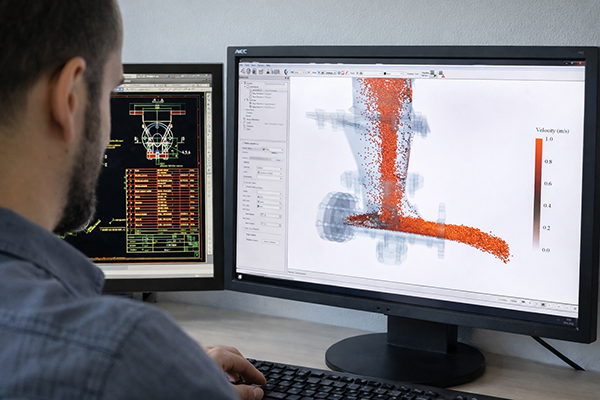
| Type of study | Bachelor |
|---|---|
| Language of instruction | Czech |
| Code | 542-0530/01 |
| Abbreviation | MSPZ |
| Course title | Modelling and simulation of process equipment |
| Credits | 4 |
| Coordinating department | Department of Mining Engineering and Safety |
| Course coordinator | doc. Ing. Jiří Rozbroj, Ph.D. |
Subject syllabus
1. Familiarization with the installation and operation of the application for 3D design, basic principle, application (sketch, part, assembly, parametric modeling)
2. Getting to know the environment, ribbons and menus, graphics window, saving files, file versions, zoom, panning, coordinate system, drawing scale, setting units and properties
3. Drawing basic objects in the component sketch environment, coordinate system, planes and axes of the coordinate system, methods of connecting elements, chamfering and rounding, trimming and extending
4. Drawing with the aim of achieving the creation of a 3D object of the part using the finished sketch, rotation methods, extraction, shell, helix and others
5. Options and adjustments to the created 3D components, creating a sketch and an element on the component, mirroring, fields, extruding, merging, difference, projecting the sketch, working with the working plane
6. Creation of assemblies from components, options for linking components in the coordinate system, options for links between components, export and import of components in different file formats
7. Creation of a model with specific requirements for the model for import into DEM applications
8. Input parameters to DEM and their settings
9. Possibilities of 3D model in the DEM environment, programming movements, adding partial elements
10. Assignment of specific properties to geometries and creation of simulation material
11. Creation of generation geometries for the creation of particles
12. Creating export data from simulations and working with them
13. Possible optimization of the computing environment
2. Getting to know the environment, ribbons and menus, graphics window, saving files, file versions, zoom, panning, coordinate system, drawing scale, setting units and properties
3. Drawing basic objects in the component sketch environment, coordinate system, planes and axes of the coordinate system, methods of connecting elements, chamfering and rounding, trimming and extending
4. Drawing with the aim of achieving the creation of a 3D object of the part using the finished sketch, rotation methods, extraction, shell, helix and others
5. Options and adjustments to the created 3D components, creating a sketch and an element on the component, mirroring, fields, extruding, merging, difference, projecting the sketch, working with the working plane
6. Creation of assemblies from components, options for linking components in the coordinate system, options for links between components, export and import of components in different file formats
7. Creation of a model with specific requirements for the model for import into DEM applications
8. Input parameters to DEM and their settings
9. Possibilities of 3D model in the DEM environment, programming movements, adding partial elements
10. Assignment of specific properties to geometries and creation of simulation material
11. Creation of generation geometries for the creation of particles
12. Creating export data from simulations and working with them
13. Possible optimization of the computing environment
E-learning
Literature
O’sullivan Catherine. Particulate Discrete Element Modelling: A Geomechanics Perspective. Spon Press, 2011. ISBN 978-0-415-49036-8
McGlinchey, D. (Ed.) (2023). Simulations in Bulk Solids Handling: Applications of DEM and Other Methods. Wiley-VCH.
Cundall, P. A.; Strack, O. D. L. (1979). “A discrete numerical model for granular assemblies.” Géotechnique, 29(1), 47–65.
Altair. Altair EDEM 2021.0. © 2023 Altair Engineering Inc. Available at: https://2022.help.altair.com/2022.2/EDEM/Getting_Started_with_the_EDEM_User_Interface.htm
Polák, Jaromír, Jiří Pavliska A Aleš Slíva. Dopravní a manipulační zařízení I. Ostrava: VŠB - Technická univerzita Ostrava, 2001. ISBN 80-248-0043-8.
Polák, Jaromír, Karel Bailotti, Jiří Pavliska A Leopold Hrabovský. Dopravní a manipulační zařízení II. Ostrava: VŠB - Technická univerzita Ostrava, 2003. ISBN 80-248-0493-X.
McGlinchey, D. (Ed.) (2023). Simulations in Bulk Solids Handling: Applications of DEM and Other Methods. Wiley-VCH.
Cundall, P. A.; Strack, O. D. L. (1979). “A discrete numerical model for granular assemblies.” Géotechnique, 29(1), 47–65.
Altair. Altair EDEM 2021.0. © 2023 Altair Engineering Inc. Available at: https://2022.help.altair.com/2022.2/EDEM/Getting_Started_with_the_EDEM_User_Interface.htm
Polák, Jaromír, Jiří Pavliska A Aleš Slíva. Dopravní a manipulační zařízení I. Ostrava: VŠB - Technická univerzita Ostrava, 2001. ISBN 80-248-0043-8.
Polák, Jaromír, Karel Bailotti, Jiří Pavliska A Leopold Hrabovský. Dopravní a manipulační zařízení II. Ostrava: VŠB - Technická univerzita Ostrava, 2003. ISBN 80-248-0493-X.
Advised literature
Zegzulka, J. Mechanika sypkých hmot. Ostrava: VŠB - Technická univerzita Ostrava, 2004. ISBN 80-248-0699-1.
Cundall, P. A.; Strack, O. D. L. (1979). “A discrete numerical model for granular assemblies.” Géotechnique, 29(1), 47–65.
McGlinchey, D. (Ed.) (2023). Simulations in Bulk Solids Handling: Applications of DEM and Other Methods. Wiley-VCH.
Schulze, D. Flow Properties of Powders and Bulk Solids. 2011.
Cundall, P. A.; Strack, O. D. L. (1979). “A discrete numerical model for granular assemblies.” Géotechnique, 29(1), 47–65.
McGlinchey, D. (Ed.) (2023). Simulations in Bulk Solids Handling: Applications of DEM and Other Methods. Wiley-VCH.
Schulze, D. Flow Properties of Powders and Bulk Solids. 2011.