Základy modelování
| Type of study | Bachelor |
|---|---|
| Language of instruction | Czech |
| Code | 542-0535/01 |
| Abbreviation | ZM |
| Course title | Základy modelování |
| Credits | 2 |
| Coordinating department | Department of Mining Engineering and Safety |
| Course coordinator | Ing. Jakub Hlosta, Ph.D. |
Subject syllabus
1. Introduction to the course. Importance of technical and numerical modelling in process engineering. Engineering design process from equipment design to its digital model.
2. Fundamentals of technical drawing. Technical documentation, drawing formats, scales, line types, and principles of engineering drawing preparation.
3. Technical representation. Orthographic projection, views, sections, cross-sections, and detail views.
4. Dimensioning, dimensional and geometrical tolerances. Basic principles of preparing manufacturing drawings.
5. Fundamentals of engineering design practice. Standardized machine components, joints, threads, and basic design principles.
6. Introduction to 3D CAD modelling. Principles of parametric modelling and the Autodesk Inventor user environment.
7. Creation of 2D sketches and parametric 3D models of components. Constraints, dimensional parameters, and basic modelling operations.
8. Assembly modelling. Constraints between components, standardized components, and basic principles of mechanical assembly design.
9. Preparation of technical documentation from 3D CAD models. Part and assembly drawings, sections, dimensioning, and bills of materials.
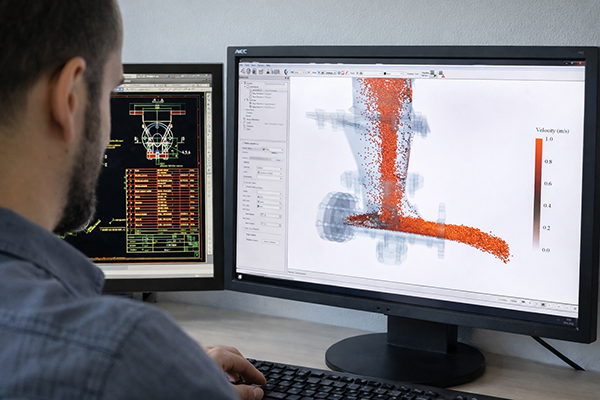
10. Introduction to numerical modelling of particulate materials. Characteristics of bulk materials and principles of the Discrete Element Method (DEM).
11. Basic structure of a DEM model. Particles, geometry, material properties, contact models, and boundary conditions.
12. EDEM environment. Import of CAD geometry, particle generation, material definition, and basic simulation setup.
13. Running and evaluating DEM simulations. Visualization of particle motion, velocities, forces, material flow, and applications of DEM in process engineering
2. Fundamentals of technical drawing. Technical documentation, drawing formats, scales, line types, and principles of engineering drawing preparation.
3. Technical representation. Orthographic projection, views, sections, cross-sections, and detail views.
4. Dimensioning, dimensional and geometrical tolerances. Basic principles of preparing manufacturing drawings.
5. Fundamentals of engineering design practice. Standardized machine components, joints, threads, and basic design principles.
6. Introduction to 3D CAD modelling. Principles of parametric modelling and the Autodesk Inventor user environment.
7. Creation of 2D sketches and parametric 3D models of components. Constraints, dimensional parameters, and basic modelling operations.
8. Assembly modelling. Constraints between components, standardized components, and basic principles of mechanical assembly design.
9. Preparation of technical documentation from 3D CAD models. Part and assembly drawings, sections, dimensioning, and bills of materials.
10. Introduction to numerical modelling of particulate materials. Characteristics of bulk materials and principles of the Discrete Element Method (DEM).
11. Basic structure of a DEM model. Particles, geometry, material properties, contact models, and boundary conditions.
12. EDEM environment. Import of CAD geometry, particle generation, material definition, and basic simulation setup.
13. Running and evaluating DEM simulations. Visualization of particle motion, velocities, forces, material flow, and applications of DEM in process engineering
E-learning
LMS
Literature
KLETEČKA, Jaroslav a FOŘT, Petr. Technické kreslení. Druhé opravené vydání. Učebnice. Brno: Computer Press, 2012. ISBN 978-80-251-1887-0.
FOŘT, Petr a KLETEČKA, Jaroslav. Autodesk Inventor: funkční navrhování v průmyslové praxi. Učebnice. Brno: Computer Press, a. s, 2007. ISBN 978-80-251-1773-6.
ZEGZULKA, Jiří. Mechanika sypkých hmot. Ostrava: Vysoká škola báňská - Technická univerzita, 2004. ISBN 80-248-0699-1.
MCGLINCHEY, Don. Simulations in Bulk Solids Handling: Applications of DEM and other Methods. John Wiley, 2023. ISBN 978-3-527-83592-8 .
FOŘT, Petr a KLETEČKA, Jaroslav. Autodesk Inventor: funkční navrhování v průmyslové praxi. Učebnice. Brno: Computer Press, a. s, 2007. ISBN 978-80-251-1773-6.
ZEGZULKA, Jiří. Mechanika sypkých hmot. Ostrava: Vysoká škola báňská - Technická univerzita, 2004. ISBN 80-248-0699-1.
MCGLINCHEY, Don. Simulations in Bulk Solids Handling: Applications of DEM and other Methods. John Wiley, 2023. ISBN 978-3-527-83592-8 .
Advised literature
JANÍČEK, Přemysl. Systémové pojetí vybraných oborů pro techniky: hledání souvislostí: učební texty. Brno: Akademické nakladatelství CERM, 2007. ISBN 978-80-7204-554-9.
PAVLISKA, Jiří a HRABOVSKÝ, Leopold. Dopravní a manipulační zařízení IV. Ostrava: Vysoká škola báňská - Technická univerzita, 2004. ISBN 80-248-0537-5.
FEDA, Jaroslav. Základy mechaniky partikulárních látek. Praha: Academia, 1977.
Dokumentace a uživatelská příručka Altair EDEM. Dostupné online na https://help.altair.com/edem/index.htm
PAVLISKA, Jiří a HRABOVSKÝ, Leopold. Dopravní a manipulační zařízení IV. Ostrava: Vysoká škola báňská - Technická univerzita, 2004. ISBN 80-248-0537-5.
FEDA, Jaroslav. Základy mechaniky partikulárních látek. Praha: Academia, 1977.
Dokumentace a uživatelská příručka Altair EDEM. Dostupné online na https://help.altair.com/edem/index.htm