DESIGN IN ARCHITECTURE AS PART OF THE UNIVERSITY ENVIRONMENT
The delimited part of the budget for capital construction, which was intended for fine art addition to the new premises, did not always need to be used only to create a work of art such as sculpture, relief, mosaics, etc. For example, the design decoration of the buildings could also be covered by these funds. Even design elements were often created by the same artists who also created the works of art, although there was a group within them specializing in this particular fine art industry (graphic designers from an area of typography, or artists working with metal).
An architectural design can be specified in particular as a design, but also as a realization, of a certain, essential, or desired element of a structure, which reflects both its functional and aesthetic aspects. So, we can consider quite a wide range of objects as a design element, of which only a small part was created in the context of contracts for the so-called monumental realizations. As a result, architecture is complemented by a number of design elements designed by artists working directly for large-scale industrial manufacturers. These include, for example, doors and windows, switches, a large proportion of light fittings, furniture, and/or various devices. At the moment, however, we will be interested in the design elements that have been created as something unique for a particular building or structure. The most common are the various inscriptions on the buildings and in them, information emblems, national emblems, illuminating elements of the ceremonial spaces, bunting flagpoles, etc.
Name:
Designation of the new building of the Rectorate building and departments in Ostrava-Poruba, including the national emblem (1976)
Commemorative inscription on a stone plaque inside the lobby of the Rectorate building (1976)
Plaque of authors (1977)
Table indicating the origin of the coal boulder (first installed in the lobby of the building in front of Gajda’s sandstone relief, later in the middle of the lobby of the circular auditorium) (1977)
Author: Ostrava graphic artist Karel Štětkář (1918–1999)
Location: the entrance and the lobby of the Rectorate building
Execution: bronze
A commemorative inscription with the university emblem and important dates from the history of Czechoslovak mining education (from the founding of the Mining school in Jáchymov in 1716 through the establishment of a Mining Academy in Příbram in 1849 and its relocation to Ostrava in 1945 to the beginning of the construction of a new campus in Poruba in 1973) can be found in the lobby to this day. It was only a change of the political regime in 1989 that caused its modification. Thanks to the change, today we can no longer read that the construction of the campus was decided not only by the government of the Czechoslovak Socialist Republic but also by the Central Committee of the Communist Party. Also, the reference to the “heroic Soviet army” liberating Czechoslovakia was omitted. The fact is that the commemorative inscription was created for the 30th anniversary of the liberation.
Name: state emblem (after 1989 replaced), inscription and emblem on the building of the Faculty of Economics
Authors: Vladislav Gajda (1925–2010) and Jan Gajda (1950–2012),
Dating: 1980–1981
Location: the facade of the Faculty of Economics in Sokolská Street in Moravian Ostrava
Execution: bronze
The building of today’s Faculty of Economics in Sokolská Street in Moravian Ostrava was completed with the inscriptions, emblem and national emblem by Vladislav Gajda (1925–2010) together with his son Jan Gajda (1950–2012) in 1980–1981, when the faculty was moved there after the relocation of the Faculty of Metallurgy to Poruba. They were also supposed to be made of bronze since this durable and solid material ensured both a high-quality result and long life, which was considered to be significant with respect to a social effect. While the national emblem was changed following the political changes, the University emblem with the inscription can be found on a column on the right side of the main entrance to the building to this day.
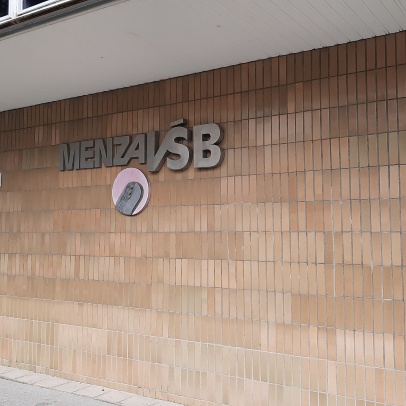
Name: Inscription and emblem on the building of the University Cafeteria
Author: Aleš Stanovský (*1952)
Dating: 1987
Location: in the exterior on a pillar at the entrance to the New University Cafeteria building
Execution: stainless steel sheet, red-lacquered sheet metal, stone relief
However, it was not only the main entrances of the most important buildings of the University that were supplemented by inscriptions in the past. Virtually all specialized buildings required markings. To this day, such a design inscription can be found on the University Cafeteria building in Ostrava-Poruba. The author of the inscription and the attached artistically rendered emblem is Aleš Stanovský (*1952), a graphic artist and designer specializing in working with metal. While the modern inscription “VŠB Cafeteria” is made of stainless steel, the attached emblem, depicted as a red circle (probably symbolizing a plate) is made of lacquered sheet metal, and the part from which the shapes of cutlery protrude is made of stone.
Name: Inscription wall in the Geological Pavilion
Author: Vladivoj Jindřich (1950–2001).
Dating: 1987
Location: in the interior on the wall of the Geological Pavilion in Ostrava-Poruba
Execution: bronze inscription on a circular background
On the first floor of the Geological Pavilion in Ostrava-Poruba, there is something that could be considered a commemorative plaque, but it is made of a bronze inscription on a circular object projecting from the wall. A relatively extensive inscription informs about the origin of the geological collections of VŠB – Technical University of Ostrava, the basis of which was established by Prof. František Pošepný, after whom the pavilion also received its name, mentions other cooperating institutions (Ostrava-Karviná Mines and Ore Mines Jeseník), and ultimately proclaims the proposition that all the wealth enriching society comes from the ground. In the lower part, a small circle is separated from a big white circle, which serves as an emblem with a druse projecting from it. The author of the entire concept, which highly praised during the approval by an art committee in 1987, was the graphic artist Vladivoj Jindřich (1950–2001) from Krnov.
Name: Bunting Flagpoles
Author: Koce Krstovský (architectural collaboration with Vladimír Svoboda)
Dating: 1973–1974
Location: in the space in front of the main entrance to the VŠB-TUO Rectorate building in Ostrava-Poruba
Execution: metal
The object on the border between design and architecture is the bunting flagpoles, which arose in 1973–1974 outside the new building for the faculties in Ostrava-Poruba. After all, they were primarily designed by architects. The task was assigned to the architect of Greek origin Koce Krstovský. He was supposed to cooperate with the Třinec artist Petr Boreček (*1949), who, however, did not accept the cooperation. The art committee then commissioned architect Vladimír Svoboda (*1934) with the co-authorship. The artistic supervision was ensured by an author of the general art plan of the structure, the painter Martin Sladký (1920–2016), and a commissioned consultant, the sculptor Antonín Ivanský (1910–2000).
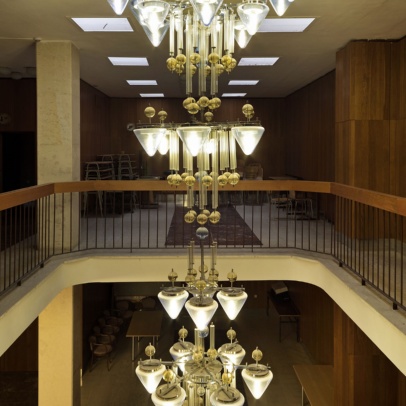
Name: Design lighting
Author: unknown
Dating: at the turn of the 1080s and 1990s
Location: a two-storey hall on the third to fourth floors in the New Library building in Ostrava-Poruba
Execution: stained glass
Various chandeliers and other illuminating bodies (sometimes also called light installations) became a frequent design element. We can encounter at least one such object at VŠB – Technical University of Ostrava. It was likely created at the turn of the 1980s and the 1990s for the lecture hall that occupied space on the third and fourth floor of the newly built central library in Ostrava-Poruba. An elongated chandelier made of coloured glass is hung in the central area of this two-story lecture hall. Unfortunately, we are yet to learn of its author.
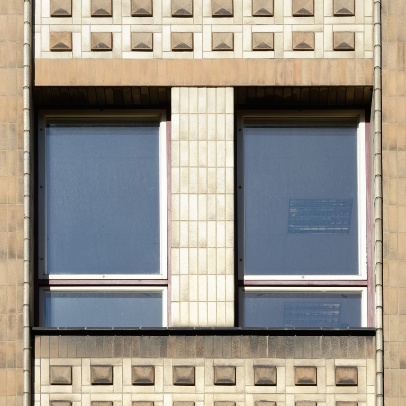
Name: Decorative tile facing
Author: Alois Houba
Dating: 1954–1956
Location: Facades of the Faculty of Economics (originally the Faculty of Metallurgy) in Moravian Ostrava
Execution: atypical ceramic tiles
A quite specific type of design is the tile facing of the building of the former Faculty of Metallurgy, now the seat of the Faculty of Economics in Moravian Ostrava, built between 1954–1956. Tiling is a classic example of large-scale design products, where the architect more often chooses from an array of existing product types. However, for the building of VŠB – Technical University of Ostrava, atypical tiles were used that were designed directly by the architect Alois Houba. He did not just use typical longitudinal tiles of different dimensions on the building, but also decorative elements made of the same material and in the same colour shades, which mainly decorate windows and window sills. The same tiles (but with the omission of decorative elements that were soon out of fashion) were also used in the early 1960s to unify the facades of older university buildings that adjoined the new faculty building in Sokolská Street and Českobratrská Street.