The Best Young Scientists and Educators Receive the Werner von Siemens Awards
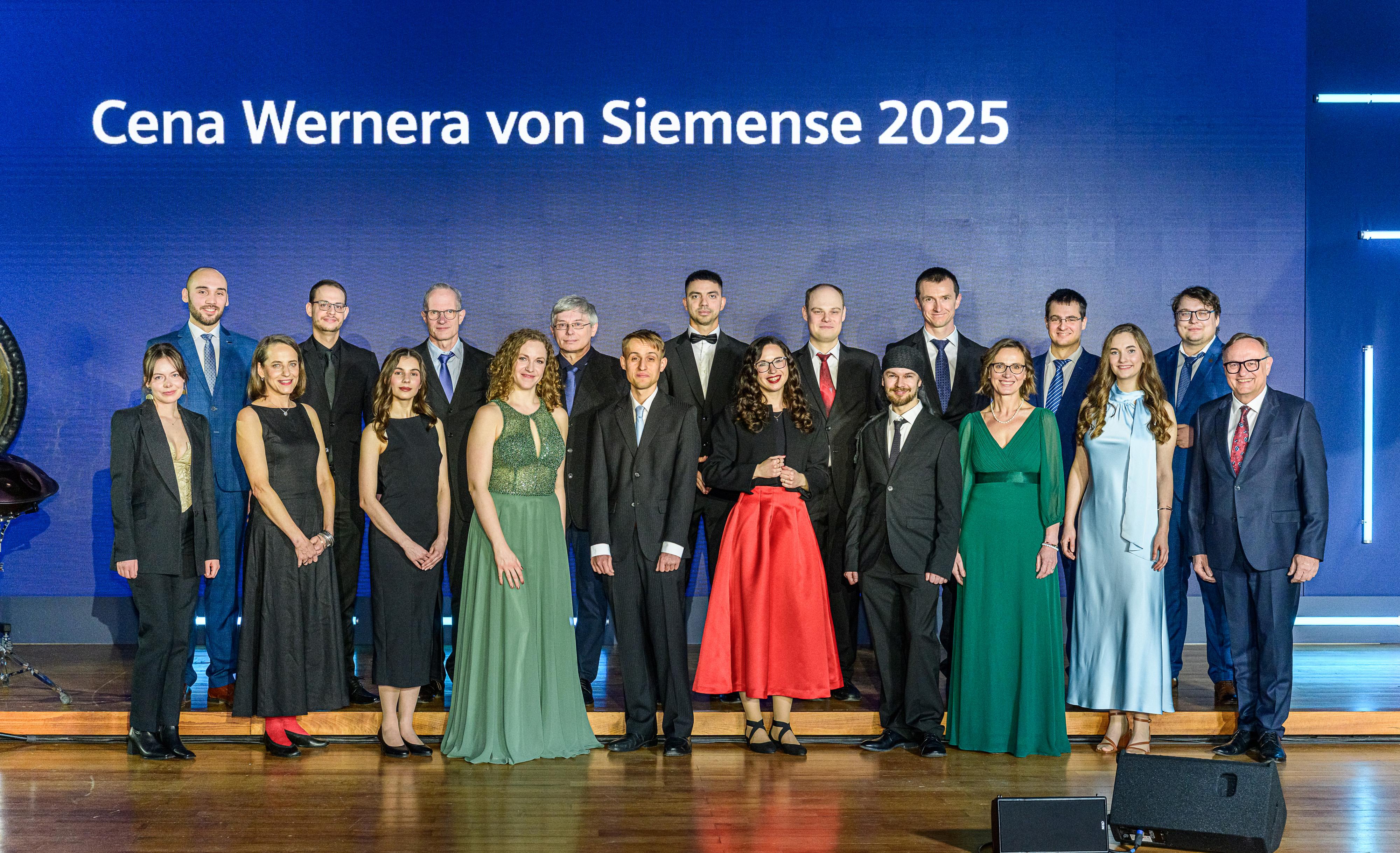
Siemens Czech Republic has presented the Werner von Siemens Awards for 2025 to the best students, young scientists, and educators. The winning works in the fields of engineering and natural sciences were selected by expert juries in the following categories: Best Basic Research Result, Best Master’s Thesis, Best Doctoral Thesis, and Best Educator. Along with the students, the supervisors and advisors of the awarded theses also receive recognition. Special awards were also granted for outstanding quality of women’s scientific work and for graduate theses addressing topics related to the Industry 4.0 concept as well as smart infrastructure and energy.
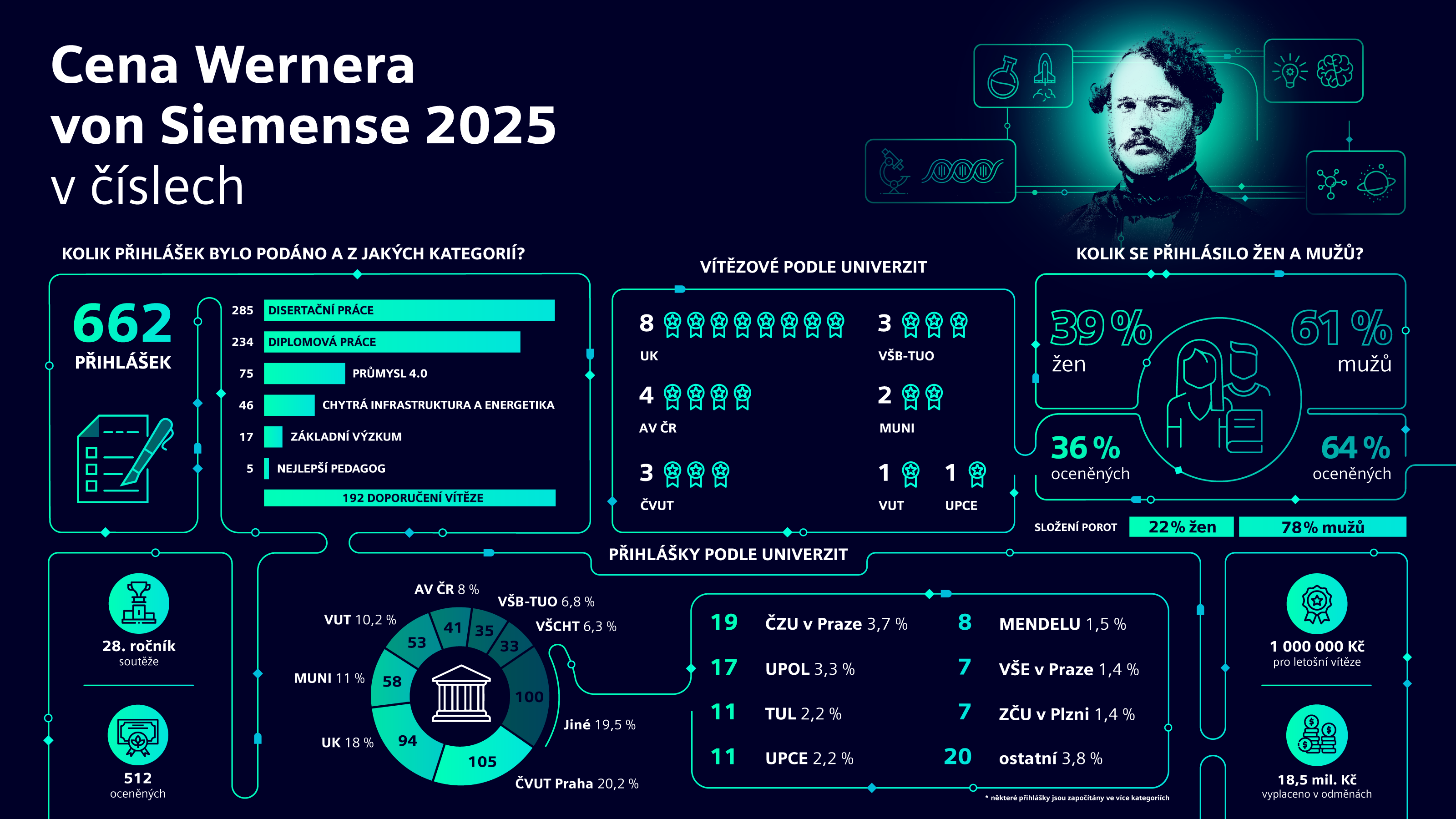
The expert juries evaluated 662 submissions, and 22 awardees shared a total prize of one million Czech crowns. Women represented 39% of all applicants and 36% of the award recipients. The most awards went to Charles University (8 awards), followed by the Czech Academy of Sciences (4 awards), the Czech Technical University in Prague and VSB – Technical University of Ostrava (3 awards each), Masaryk University (2 awards), and Brno University of Technology and the University of Pardubice (1 award each). Since the competition began, a total of CZK 18.5 million has been awarded to the winners.
“The awarded works and personalities of the 28th year of the Werner von Siemens Awards demonstrate the outstanding quality of our technical and scientific universities. We live in a time when boundaries—geographical, value-based, and moral—are increasingly being defined. In this context, the importance of science is growing, because science knows no borders. Science and research unite us—their clarity, fact-based results, and universality transcend all boundaries. This year’s works are an excellent example: from breakthrough materials for nuclear fusion to intelligent collaboration between robots and humans or new methods of fighting cancer. These are the topics shaping our future. Their research is not only a scientific contribution but also proof that joint efforts to find solutions can overcome all barriers,” said Eduard Palíšek, CEO of Siemens Czech Republic.
In the category Best Doctoral Thesis, the award was presented to Pierre Koleják from the Faculty of Materials Science and Technology at VSB – Technical University of Ostrava for his dissertation titled Terahertz Time-Domain Ellipsometry Based on Spintronic Phenomena.
Solving Limitations Through the Development of a New Technique
Many modern fields that require efficient processing of high voltages and currents-such as electromobility, industrial automation, and sustainable energy-rely on a specific category of semiconductor components known as power semiconductors. However, their use in precision manufacturing has long been limited by the difficulty of verifying key properties such as conductivity and carrier dynamics, which determine whether a chip will be efficient and reliable. These properties can be investigated using terahertz radiation, which lies between infrared and microwave radiation in the electromagnetic spectrum. A suitable analytical technique is ellipsometry, a method that measures changes in the polarization of light after reflection and uses them to determine the properties of materials. However, ellipsometry had not yet been successfully implemented in the terahertz region.
In his work, Pierre Koleják overcame these challenges and extended ellipsometry into the terahertz domain, enabling the use of power semiconductors in many strategic technological fields. Notably, he completed his doctoral studies in the cotutelle format-joint supervision between the Czech Republic and France.
Development of a New Measurement Method
In his dissertation, Koleják introduced a complete time-resolved spectroscopic terahertz ellipsometry method capable of determining the full polarization response even for general real-world samples. His research included the development and integration of spintronic terahertz sources with stronger signals and controllable polarization. The result is a non-destructive diagnostic technique, tested with industrial partners on power semiconductor structures as well as on specialized optical crystals.
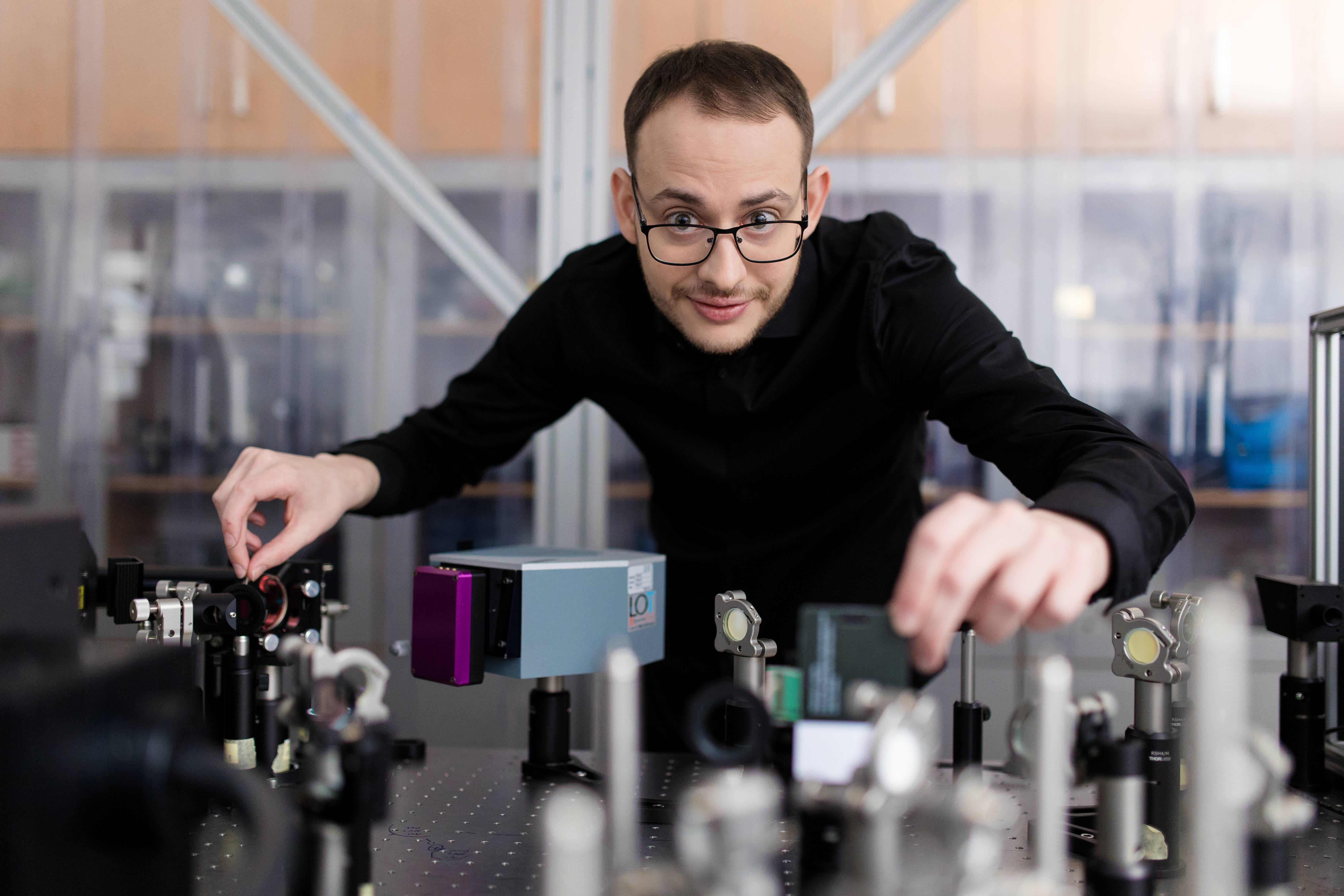
“The terahertz ellipsometer developed in this work-a measurement device similar to optical ellipsometry but sensitive to the conductivity properties of materials-enables non-destructive diagnostics of silicon carbide wafers for power electronics and could also be used for quality control in manufacturing,” explains Pierre Koleják.
“We are also verifying the methodology on crystalline materials used in space optics and considered for terabit telecommunications.”
Fascinating Physics with Strong Practical Impact
As a doctoral student, Pierre Koleják was part of two universities and two research teams led by Kamil Postava and Mathias Vanwolleghem. “I have always wanted to work on fascinating physics. I was attracted by the combination of spintronics and intense pulsed lasers. The topic involved sources that generate radiation not only through the motion of charge but also by exploiting electron spins, which at the time was a new and recently discovered phenomenon. This technology was part of a large European project involving nine scientific teams whose goal was to quickly move the technology toward practical sources. I was fortunate to experience the entire process—from concept to measurements on samples provided by companies that require clear and practical results. Research is often focused on only one stage, with another group continuing later, which disrupts continuity and slows development. Our project covered the entire cycle, which made it unique and exciting,” says Pierre Koleják.
The awarded work was conducted simultaneously in the Czech Republic and France. Each year he spent half a year in France and half a year in the Czech Republic, fulfilling the academic responsibilities at both institutions. The defense of his doctoral thesis, although held in Ostrava, had to satisfy both Czech and French requirements. The committee was international, including experts from Switzerland and Germany in addition to representatives from the Czech Republic and France.
Member of a Prestigious Research Team
Currently, Pierre Koleják works in Germany in the research group of Joachim Pupeza, who until recently led a research group under Ferenc Krausz, recipient of the Nobel Prize in Physics 2023. As part of his postdoctoral work, he is also affiliated with this renowned research environment.
He would like to continue working at the intersection of instrument development and fundamental research, this time aiming to transfer physical measurement methods into medicine.
“I would be happy if I could develop a measurement or imaging method that is as practical for medicine as X-ray, ultrasound, or CT and used on a daily basis. I would like to create something with a direct impact—ideally something that improves diagnostics and can save lives. At the same time, I know that the path to clinical practice is more demanding than in industry, but that makes it all the more interesting,” concludes Pierre Koleják.