VSB – Technical University of Ostrava (VSB-TUO) is included in a number of prestigious international rankings which assess and compare institutions of tertiary education. The rankings are compiled on the basis of fixed criteria and indicators. Some of the rankings only work with data available from databases such as the Web of Science or Scopus, others require university data or data taken from academic or employer surveys. The areas which are evaluated most often include the quality of teaching, internationalisation, research performance, including the publication of high-quality scientific papers and citations, or cooperation with the industrial sector.
International Rankings
| VSB-TUO in international rankings | |||
| Ranking | Publication year | Overall position | Key achievement |
| THE World University Rankings | 2026 | 1001–1200 | Largest year-on-year increase in the Research Quality (+8.3) |
| THE Sustainability Impact Ratings | 2026 | 401–600 | Top 100 worldwide in SDG 7 Affordable and Clean Energy (97th place) |
| QS World University Rankings | 2026 | 1001–1200 | 9th place among Czech universities |
| QS World University Rankings: Europe | 2025 | 363 | 31st place in the Eastern Europe sub-regional ranking |
| QS World University Rankings: Sustainability | 2025 | 878 | 511th place in the Governance category |
| U.S. News Best Global Universities | 2026 | 1338 | 1st in the Czech Republic for Electrical & Electronic Engineering |
| Center for World University Rankings (CWUR) | 2026 | 1661 | Best result in the Czech Republic in Employability (793rd place globally) |
On 30 September 2026, the international Times Higher Education World University Rankings 2027 was published. This edition includes 2,297 universities from 118 countries, representing an increase of 106 universities compared with the previous year.
As in the previous year, 18 Czech universities were included in the ranking. VSB – Technical University of Ostrava achieved a significant improvement in this year’s edition, placing in the 1001–1200 band. Within the Czech Republic, it shares 5th place with Czech Technical University in Prague and Palacký University Olomouc.
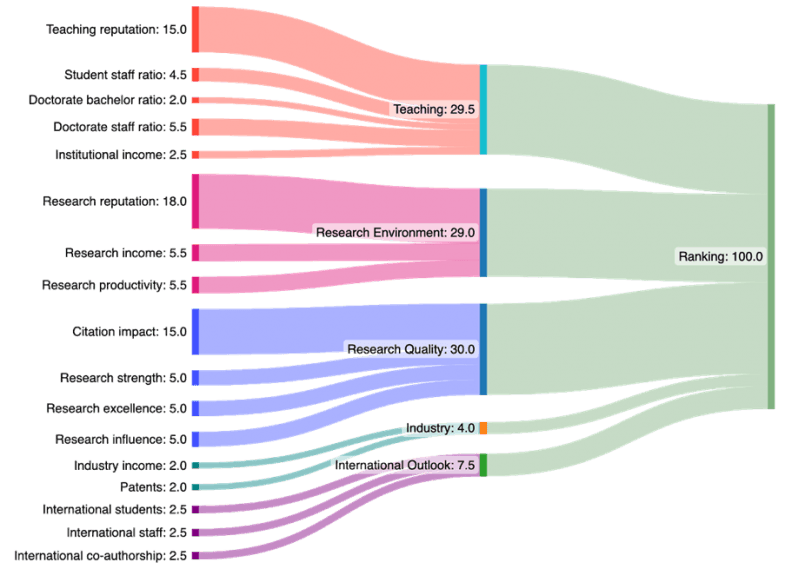
The ranking has been published by the British magazine Times Higher Education since 2010. Since 2023, universities have been evaluated according to the THE WUR 3.0 methodology. The evaluation is based on 17 indicators grouped into five thematic areas (pillars): Teaching, Research Environment, Research Quality, Industry, and International Outlook.
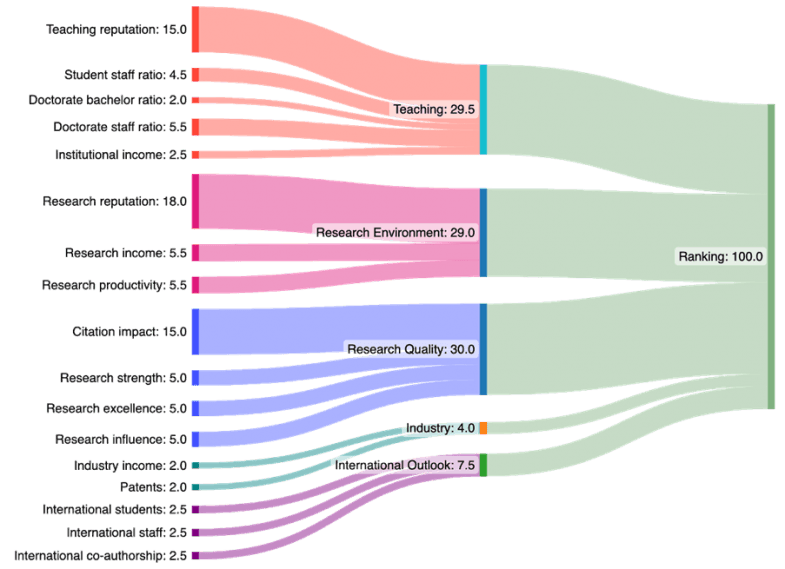
Source
The complete ranking results are available here.
A detailed profile of VSB – Technical University of Ostrava on the THE website.
VSB – Technical University of Ostrava (VSB–TUO) has once again confirmed its position among internationally ranked universities in the Times Higher Education Sustainability Impact Ratings 2026 (formerly THE Impact Rankings), marking its eighth consecutive year of participation.
The latest edition of the ranking, published by Times Higher Education on 24 June 2026, evaluates 1,603 universities from 116 countries (compared with 2,318 universities last year). The decrease of 715 evaluated institutions is primarily related to a change introduced in 2025, when THE made participation in the ranking conditional on membership in the Sustainability Impact Network. A total of seven Czech universities were included in the overall ranking.
Published since 2019, the Times Higher Education Sustainability Impact Ratings are the only global university ranking that assesses institutions according to their contribution to achieving the United Nations Sustainable Development Goals (SDGs). The SDGs were developed with the involvement of all UN member states, representatives of business, academia and civil society worldwide, and provide a strategic framework for sustainable development for the period 2015–2030.
VSB–TUO's position in the ranking
This year, VSB–TUO participated in 10 SDG categories. For the first time, the University was assessed in SDG 12 Responsible Consumption and Production and SDG 13 Climate Action, achieving a shared ranking position of 401–600 in both categories.
The University achieved its strongest result in SDG 7 Affordable and Clean Energy, where it ranked 97th out of 892 evaluated universities worldwide, placing VSB–TUO among the world’s top 100 universities contributing significantly to the development of sustainable energy solutions. Within the Czech Republic, VSB–TUO achieved the best result in this category, followed by Masaryk University and Brno University of Technology. Another strong area is SDG 11 Sustainable Cities and Communities, where the University maintained a stable position in the 101–200 range. These two categories represent VSB–TUO’s highest-ranked areas in the ranking and confirm the University’s strong position particularly in the fields of energy, infrastructure and sustainable urban development.
VSB–TUO improved its position in two categories: SDG 4 Quality Education: from 401–600 to 301–400, and SDG 9 Industry, Innovation and Infrastructure: from 601–800 to 401–600. In SDG 4, the positive development was driven mainly by the metric Research on early years and lifelong learning education, where the score increased significantly year-on-year from 55.5 to 65.8. In SDG 9, the improvement was supported primarily by two key indicators. The score for Patents citing university research increased from 73.1 to 84.9. At the same time, the area of Research income from industry and commerce improved, with the score rising from 49.8 to 52.0. A slight decline was recorded in SDG 6 Clean Water and Sanitation, where the University moved from the 101–200 range to the 201–300 range.
VSB–TUO maintained the same position in SDG 8 Decent Work and Economic Growth (301–400), and SDG 16 Peace, Justice and Strong Institutions (401–600). In the overall ranking, which is which is based on the three highest-performing SDGs together with the mandatory SDG 17 Partnerships for the Goals, VSB–TUO achieved a position in the 401–600 range.
VSB–TUO Results in the THE Sustainability Impact Ratings 2026
| Category | Position |
|---|---|
| Overall ranking | 401–600 |
| SDG 4 Quality Education | 301–400 |
| SDG 6 Clean Water and Sanitation | 201–300 |
| SDG 7 Affordable and Clean Energy | =97 |
| SDG 8 Decent Work and Economic Growth | 301–400 |
| SDG 9 Industry, Innovation and Infrastructure | 401–600 |
| SDG 11 Sustainable Cities and Communities | 101–200 |
| SDG 12 Responsible Consumption and Production | 401–600 |
| SDG 13 Climate Action | 401–600 |
| SDG 16 Peace, Justice and Strong Institutions | 401–600 |
| SDG 17 Partnerships for the Goals | 401–600 |
VSB–TUO’s position in international sustainability ratings can be considered a significant achievement, as it reflects the University’s long-term commitment to social responsibility and sustainable development.
The complete results of the THE Sustainability Impact Ratings 2026 are available here.
QS World University Rankings is an international ranking of higher education institutions that compares universities globally based on their overall quality and performance. It evaluates in particular academic reputation, employer reputation, teaching quality, research output, internationalisation, and sustainability.
The ranking has been published since 2004 by QS Quacquarelli Symonds, a British organisation specialising in higher education analysis, evaluation, and advisory services.
The latest edition, QS World University Rankings 2027, was released on 18 June 2026. In this edition, a total of 8,808 universities from 106 countries and territories were analysed, of which 1,504 institutions were included in the final ranking.
A total of 16 universities from the Czech Republic were included, the same number as in the previous year. VSB – Technical University of Ostrava maintained its position year-on-year and was ranked in the 1001–1200 band. Among Czech universities, it shares 9th place together with the University of Economics, Prague and the University of South Bohemia in České Budějovice.
The ranking is based on QS methodology consisting of nine key indicators (expanded in 2023 with three new metrics introduced for QS WUR 2024): sustainability, employability, and the International Research Network (IRN) Index.
| INDICATOR | WEIGHT |
| Academic Reputation | 30% |
| Employer Reputation | 15% |
| Faculty Student Ratio | 10% |
| Citations per Faculty | 20% |
| International Faculty Ratio | 5% |
| International Student Ratio | 5% |
| International Research Network | 5% |
| Employment Outcomes | 5% |
| Sustainability | 5% |
The full QS World University Rankings 2027 results list is available here.


Quacquarelli Symonds (QS), a British company that is the world's leading provider of services, analysis and insights into the global higher education sector, published the regional QS World University Rankings: Europe 2026 (formerly QS EECA) on 28 January 2026, ranking 958 universities from 42 countries.
A total of 18 Czech higher education institutions are included in the ranking. According to QS, universities from the Czech Republic, together with universities from Bulgaria, Hungary, Moldova, Poland, Romania, Slovakia and Ukraine, are included in the sub-regional QS Eastern Europe ranking.
VSB – Technical University of Ostrava improved its overall position, achieving a score of 33.4 (20.2 last year) and ranking 363rd in Europe (381st last year), 31st in Eastern Europe (34th last year), and 9th in the Czech Republic.
The QS World University Rankings: Europe evaluates universities based on 12 indicators:
- Academic Reputation (30%)
- Employer Reputation (15%)
- Faculty Student Ratio (5%)
- International Research Network (10%)
- Citations per Paper (10%)
- Papers Per Faculty (5%)
- International Faculty (5%)
- International Students (5%)
- Inbound Exchange Student (2.5%)
- Outbound Exchange Students (2.5%)
- Sustainability (5%)
- Employment Outcomes (5%)
The complete QS WUR Europe 2026 results are available here.

VSB-TUO has secured a place in the QS World University Rankings: Sustainability 2026. This fourth edition of the ranking, focusing on universities' sustainable development efforts, was published on 18 November 2025.
The latest edition of the ranking features 2,001 universities, marking an increase of 257 compared to the previous year. To qualify for inclusion in the QS Sustainability Rankings, institutions must be eligible for QS World University Rankings, QS Rankings by Region or QS Rankings by Subject. Additionally, the sustainability metric, accounting for 5% of the overall ranking, has been integrated into the QS World University Rankings methodology since 2023 (QS WUR 2024).
Universities are evaluated in three main categories, within which 9 thematic indicators consisting of 52 metrics are monitored.
- Environmental Impact (45%): Environmental Education (17%), Environmental Research (13%), Environmental Sustainability (15%);
- Social Impact (45%): Employability and Opportunities (11%), Equality (12%), Health and Wellbeing (5%), Impact of Education (7%), Knowledge Exchange (10%);
- Governance (10%): Good Governance (10%).
Within the Czech Republic, 15 universities have earned a place in the QS World University Rankings: Sustainability 2026, representing an increase of three compared with the previous year.
VSB-TUO ranked 878th in the overall ranking. The University achieved its best result in the global ranking in the Governance category, where it ranked 511th. This category assesses how universities apply principles of leadership and decision-making based on transparency, democracy, and inclusion.
In the Environmental Impact category, which evaluates universities' contributions to a sustainable future through their activities in environmental research, education, and operations, VSB-TUO ranked 907th.
In the Social Impact category, VSB-TUO ranked 1098th. This area considers initiatives focused on equality, diversity, and inclusion, as well as knowledge sharing (for example, through building partnerships).
|
Category |
Lens |
Indicator |
Weight |
|
(45 %) |
(17 %) |
10% |
|
|
EE2 - Alumni Impact for Environmental Sustainability - Public and Third Sector |
4% |
||
|
3% |
|||
|
(13 %) |
9% |
||
|
1% |
|||
|
ER3 - Research Center with an Environmental Sustainability Focus |
2% |
||
|
1% |
|||
|
Environmental Sustainability (15 %) |
5% |
||
|
1% |
|||
|
2% |
|||
|
ES4 - Publicly available strategy or policy on sustainable procurement and investment |
1% |
||
|
ES5 - Student Society focused on Environmental Sustainability |
1% |
||
|
1% |
|||
|
1% |
|||
|
1% |
|||
|
1% |
|||
|
1% |
|||
|
(45 %) |
Employability and Opportunities (11 %) |
3% |
|
|
EO2 - Research Impact on SDGs for Employment and Opportunities |
4% |
||
|
1% |
|||
|
2% |
|||
|
1% |
|||
|
(12 %) |
4% |
||
|
1% |
|||
|
1% |
|||
|
1% |
|||
|
1% |
|||
|
2% |
|||
|
1% |
|||
|
1% |
|||
|
(5 %) |
3% |
||
|
1% |
|||
|
1% |
|||
|
(7 %) |
3% |
||
|
1% |
|||
|
1% |
|||
|
1% |
|||
|
1% |
|||
|
(10 %) |
6% |
||
|
1% |
|||
|
2% |
|||
|
1% |
|||
|
(10 %) |
(10 %) |
1% |
|
|
1% |
|||
|
1% |
|||
|
1% |
|||
|
1% |
|||
|
1% |
|||
|
1% |
|||
|
1% |
|||
|
1% |
|||
|
1% |
Source: QS Sustainability Rankings

The U.S. News Best Global Universities Rankings is among the world's university rankings assessing the quality of research and scientific performance at higher education institutions. The ranking is published by U.S. News & World Report in collaboration with Clarivate, using data from the Web of Science database. In 2026, the 12th edition of the ranking was released, evaluating 2,250 universities from 105 countries worldwide. A total of 15 Czech universities were included in the ranking, compared to 16 in the previous edition.
The ranking is based on 13 indicators measuring global research performance. These indicators include global and regional research reputation, publication output, books, conference papers, citation impact, highly cited publications, and international research collaboration. In addition to the overall university ranking, U.S. News publishes 51 subject rankings, providing a more detailed view of institutional strengths across individual academic disciplines.
VSB-TUO's position
In the U.S. News Best Global Universities Rankings 2026-2027, VSB - Technical University of Ostrava (VSB-TUO) was ranked 1,338th worldwide and 10th among Czech universities. In 2026, VSB-TUO was included in six subject rankings and achieved the following results:
| VSB-TUO in the U.S. News Best Global Universities Rankings 2026-2027 | |||
| Subject | Global Rank | Rank in the Czech Republic | Score |
| Electrical and Electronic Engineering | 426 | 1 | 39.1 |
| Computer Science | 468 | 2 | 32.5 |
| Physical Chemistry | 479 | 2 | 42.7 |
| Engineering | 486 | 3 | 42.7 |
| Materials Science | 579 | 5 | 31.8 |
| Chemistry | 881 | 6 | 36.8 |
Source: U.S. News Best Global Universities Rankings 2026-2027.

VSB – Technical University of Ostrava (VSB-TUO) has once again been included in the 2026 edition of the Center for World University Rankings (CWUR). With a total of 21,291 universities evaluated, VSB-TUO’s position in the ranking is a significant achievement, as only the top 2,000 universities were included.
A total of 11 Czech universities were included in the ranking, the same number as in 2026. VSB-TUO holds a leading position among Czech universities in the Employability category, ranking 793rd globally. The only other Czech university included in this category is Charles University, which ranks 1,289th globally.
CWUR is a consulting organisation based in the United Arab Emirates that has published international university rankings since 2012. Its ranking is based on a methodology focusing on quality of education (25%), alumni employment (25%), quality of faculty (10%), and research performance (40%). Unlike other rankings, it primarily relies on publicly available data from the Clarivate Analytics database, does not conduct surveys among academics and researchers, and does not require universities to submit data.
|
The Center for World University Rankings (CWUR): VSB-TUO |
|||||||
|
2020-2021 |
2021-2022 |
2022-2023 |
2023 |
2024 |
2025 |
2026 |
|
|
World Rank |
1912 |
1883 |
1801 |
1804 |
1802 |
1744 |
1661 |
|
Regional Rank |
n/a |
628 |
594 |
n/a |
586 |
561 |
530 |
|
National Rank |
12 |
11 |
10 |
10 |
10 |
10 |
10 |
|
Education Rank |
- |
- |
- |
- |
- |
- |
- |
|
Employability Rank |
718 |
643 |
640 |
648 |
792 |
793 |
793 |
|
Faculty Rank |
- |
- |
- |
- |
- |
- |
- |
|
Research Rank |
1869 |
1850 |
1779 |
1779 |
1743 |
1684 |
1610 |
|
Overall Score |
66.1 |
66.2 |
66.5 |
66.7 |
66.8 |
67.2 |
67.4 |
|
Top % |
n/a |
n/a |
9.2 |
8.8 |
8.6 |
8.2 |
7.9 |
For more details, you can access the CWUR 2026 results here.
On 3 July 2024, the Centre for Science and Technology Studies (CWTS) at Leiden University in the Netherlands published the CWTS Leiden Ranking 2024, which compares the scientific performance of 1,506 universities (1,411 last year) from 72 countries. This ranking features universities that have produced at least 800 publications indexed in Web of Science in the period 2019 - 2022. Only so-called core publications, publications in international scientific journals, are counted. Also, only research and review articles are taken into account; other types of publications are not considered. In addition, publications produced in collaboration are counted fractionally.
Nine domestic universities appeared on the CWTS Leiden Ranking 2024 list, the same number as in the previous year (in alphabetical order): Brno University of Technology, Charles University, Masaryk University, Palacký University Olomouc, the Czech Technical University in Prague, the Czech University of Life Sciences Prague, the University of Chemistry and Technology, Prague, the University of South Bohemia in České Budějovice, and VSB - Technical University Ostrava.
This ranking assesses 4 main areas: Scientific Impact, International Collaboration, Open Access and Gender, and provides statistics not only at the level of science as a whole, but also at the level of the 5 main fields of science:
- Biomedical and Health Sciences,
- Life and Earth Sciences,
- Mathematics and Computer Science,
- Physical Sciences and Engineering,
- Social Sciences and Humanities.
The authors of the rankings do not attempt to produce a universal ranking, but instead offer the possibility to compile a ranking according to different indicators. The ranking offers the possibility of a more detailed selection of parameters and therefore there are several versions of the final ranking. Unlike other rankings, academic reputation or teaching quality is not assessed and data from universities is not required.
The CWTS Leiden Ranking 2024 results:
https://www.leidenranking.com/ranking/2024/list
CWTS Leiden Ranking 2011/2012-2024 results available for download:
https://www.leidenranking.com/downloads