The research team from the Faculty of Safety Engineering at VSB – Technical University of Ostrava focused on critical scenarios related to hydrogen pressure storage.
The aim was to verify the behaviour of pressure systems under conditions that may occur during real emergency situations and cannot be fully simulated in laboratory environments.
Testing under extreme conditions
During the experimental week, several key measurements were carried out. One of them focused on testing the resistance of composite pressure cylinders used in hydrogen vehicles under fire conditions, with particular attention to their stability and the response of safety valves under high thermal loads.
Another part consisted of destructive tests of steel pressure cylinders filled with hydrogen and nitrogen. These experiments were aimed at verifying fragmentation theory during explosions and analysing the dispersion of fragments of the pressure vessel shell after failure.
The measurements also included tests with a hydrogen vehicle, which highlighted the specific characteristics of emergency response for this type of technology—especially the different behaviour of composite pressure vessels compared to traditional steel systems.
.jpg?attachmentId=5325&image=true)
Data for research and practice
The experiments provided valuable data that significantly expand current knowledge on the safety of hydrogen technologies. The results will be used not only for further research and scientific publications, but also as a basis for developing safety measures and training emergency response units.
As emphasized by CESAR coordinator Vojtěch Jankůj:
“Only through real tests under extreme conditions can we truly understand the behaviour of hydrogen systems. The data obtained allow us not only to refine safety measures, but above all to better prepare emergency responders for situations that cannot be fully simulated. This is where the greatest benefit of these tests lies.”
Cooperation across institutions
The experiments were carried out in cooperation with a number of partners from both research and practice. The Faculty of Safety Engineering and the Centre of Excellence for Safety Research (CESAR) collaborated with institutions including
- CEET – Centre for Energy and Environmental Technologies,
- the Faculty of Civil Engineering at VSB – Technical University of Ostrava,
- the Faculty of Mining and Geology at VSB – Technical University of Ostrava (Department of Geoinformatics),
- the University of Defence,
- the Czech Armed Forces,
- the Fire Rescue Service of the Czech Republic (including the Rescue Unit of the FRS CR, the Fire Rescue Service of the Karlovy Vary Region and the Fire Rescue Service of the City of Prague),
- and the Police of the Czech Republic.
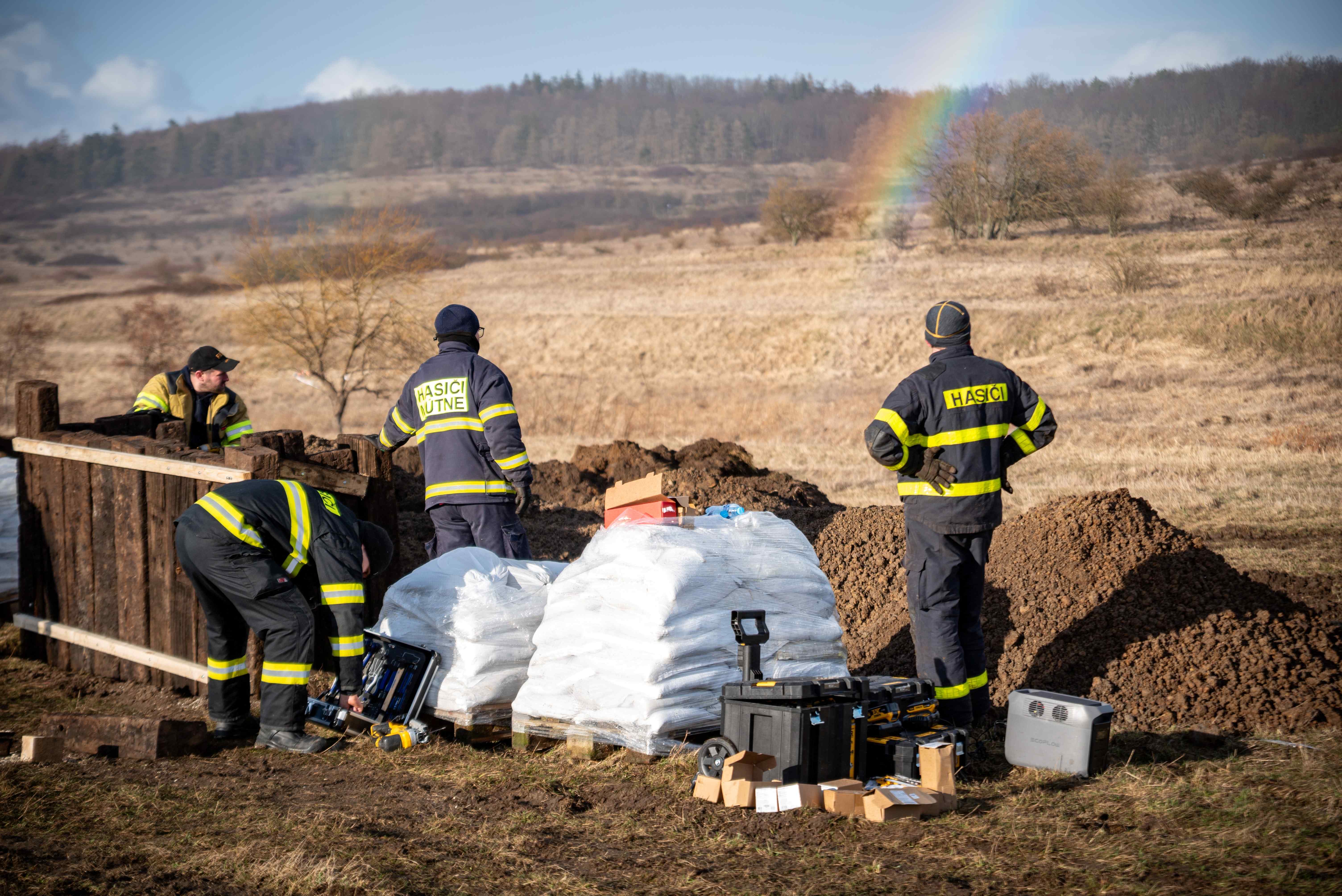
Students involved in the experiments
Students at all levels of study actively participated in both the preparation and execution of the measurements. They were involved in technical support, documentation, and field data collection. The results obtained will be further used in their final theses and in subsequent research activities.
Next steps
The implementation of the experiments was both organizationally and technically demanding and required careful coordination of all involved partners. The second phase builds on previous results while opening the way for detailed evaluation and interpretation.
The collected data will be further analysed and used in the development of safety standards and measures for the safe use of hydrogen technologies in practice.
The experiments were carried out within the project REFRESH – Research Excellence For REgion Sustainability and High-tech Industries (reg. no. CZ.10.03.01/00/22_003/0000048), specifically within Experimental Laboratory EL 4 – Laboratory for Combustion and Explosion Research.