In the QS World University Rankings 2027 (QS WUR 2027), the University remains in the 1001–1200 band, the same as last year. Within the Czech Republic, it shares 9th place with the Prague University of Economics and Business and the University of South Bohemia in České Budějovice. In the eighth edition of the THE Sustainability Impact Ratings 2026 (formerly THE Impact Rankings), it again placed in the 401–600 band. This year, the University participated in ten categories and was newly evaluated in two of them.
In QS WUR 2027, a total of 8,808 universities (compared to 8,467 last year) from 106 countries were analysed. Of these, 1,504 institutions made it into the ranking, including 16 Czech universities. Overall, one Czech university improved its position, nine declined, five remained stable, and one institution – Prague University of Economics and Business – entered the ranking for the first time.
“VSB-TUO maintained the same position as last year. Out of nine criteria on which the ranking methodology is based, it improved its score in the Faculty Student Ratio, International Faculty Ratio, Citations per Faculty, Sustainability, and Employment Outcomes. It achieved its best global ranking in the International Student Ratio, where it placed 551st, and in Faculty Staff Ratio, where it ranked 617th. In the categories of Academic Reputation and Employer Reputation, it maintained its position in the 701+ band, as in the previous year,” said Kateřina Angus, International Evaluation and Rankings Officer at VSB-TUO.
The highest-ranked Czech universities in QS WUR 2027 are Charles University (273rd), Czech Technical University in Prague (432nd), and Masaryk University (454th). Globally, the ranking continues to be led by the Massachusetts Institute of Technology (MIT). Imperial College London holds second place jointly with Stanford University, which has moved up in the rankings. The University of Oxford and Harvard University remain in fourth and fifth place. The United States has the highest number of ranked institutions (184), followed by the United Kingdom (93) and China (85). China recorded the highest number of newly included universities (13), followed by Germany (11) and Spain (10).
THE Sustainability Impact Ratings 2026
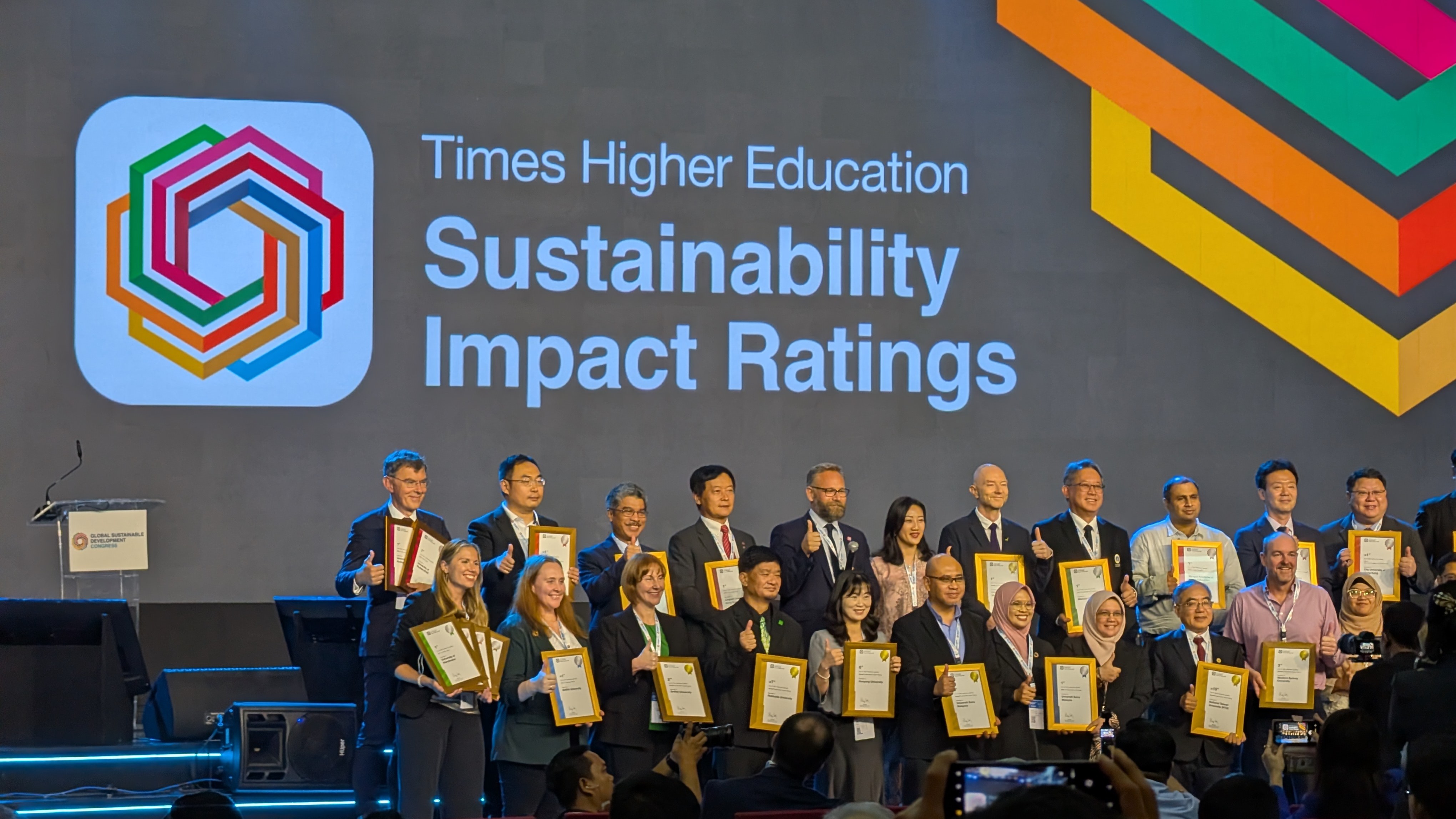
In the latest edition of the THE Sustainability Impact Ratings 2026, which is the only global university ranking focused on universities’ contribution to the United Nations Sustainable Development Goals (SDGs), a total of 1,603 universities from 116 countries were included in the overall assessment (compared to 2,318 last year). The decrease of 715 institutions is mainly due to a change introduced in 2025, when THE made participation in the ranking conditional on membership in the Sustainability Impact Network.
The ranking evaluates universities across four key areas: research, stewardship, outreach, and teaching. Institutions may submit data for all 17 SDGs, but inclusion in the overall ranking requires reporting on SDG 17 – Partnerships for the Goals and at least three additional SDGs.
VSB-TUO participated in ten SDG categories and was newly ranked in SDG 12 – Responsible Consumption and Production and SDG 13 – Climate Action, both in the 401–600 band. It also ranked in the 401–600 band for SDG 17 – Partnerships for the Goals.
VSB–TUO remains a leader in energy
“The University achieved its most significant success in SDG 7 – Affordable and Clean Energy, where it ranked 97th, compared to 71st place in 2025, out of a total of 892 evaluated higher education institutions. Despite a year-on-year decline in ranking, it maintained its position among the world’s top 100 universities that significantly contribute to the development of sustainable energy solutions. Within the Czech Republic, VSB-TUO holds first place in this area, followed by Masaryk University and Brno University of Technology. Another strong area is SDG 11 – Sustainable Cities and Communities, where the University maintained a stable position in the 101–200 band and ranks second nationally. These two categories represent the University’s best-performing areas in the ranking and confirm its strong position, particularly in energy, infrastructure, and sustainable urban development,” Angus explained.
Improvements in education quality and innovation
Year-on-year improvements were recorded in SDG 4 – Quality Education, where the University moved from the 401–600 band to 301–400, ranking fourth in the Czech Republic. Progress was also achieved in SDG 9 – Industry, Innovation and Infrastructure, improving from 601–800 to 401–600. In SDG 4, the improvement was driven mainly by the metric “Research on early years and lifelong learning education,” where the score increased significantly from 55.5 to 65.8. In SDG 9, progress was supported by two key metrics: “Patents citing university research” (increasing from 73.1 to 84.9) and “Research income from industry and commerce” (rising from 49.8 to 52.0).
Seven Czech universities were included in the overall ranking, a decrease of six institutions compared to the previous year. The best-ranked Czech institution is Masaryk University (201–300), followed by Charles University (301–400). Three universities share the 401–600 band: Czech University of Life Sciences Prague, Palacký University Olomouc, and VSB – Technical University of Ostrava.
The eighth edition of the ranking is led by the University of Manchester (UK), ending the four-year dominance of Western Sydney University. The University of Manchester moved up from second place last year, securing its second-ever top position in the history of the ranking, having last led it in 2021. Western Sydney University placed third, behind Griffith University in Queensland.
Text: Martina Šaradínová
Photo: archive of Marcel Šihor